
For years, buying health insurance in India came with a bitter pill to swallow: a hefty 18% tax on top of your premium. If you bought a policy for your family, you weren’t just paying for protection; you were paying a “luxury” tax on a basic necessity.
But if you are reading this in 2026, the landscape has completely changed. In a landmark decision in September 2025, the GST Council finally addressed the long-standing demand of millions of Indians. They scrapped the tax on personal policies, making healthcare protection significantly more affordable.
However, the exemption isn’t a blanket rule for everyone. There is still a divide between personal plans and the ones your boss buys for you. This guide breaks down exactly how GST on health insurance works today and what it means for your wallet.
The Big Change: 0% GST for Individuals
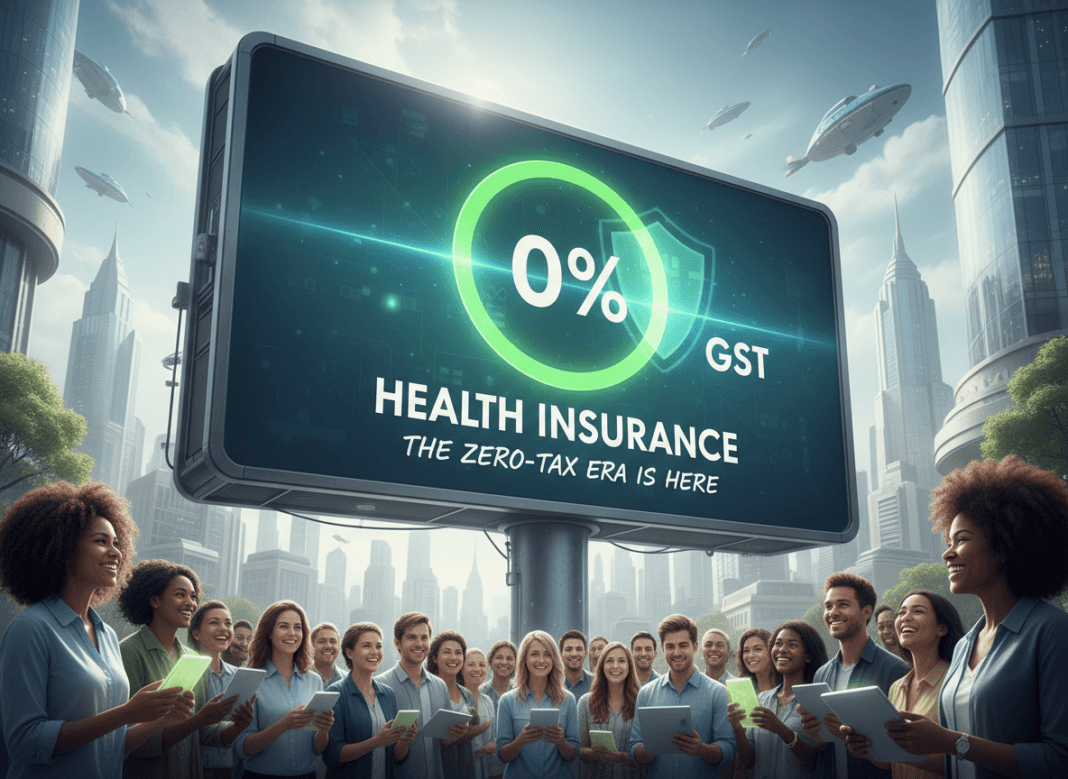
Effective from September 22, 2025, the Goods and Services Tax (GST) rate on individual health insurance policies was reduced from 18% to Nil (0%).
This exemption applies to:
- Individual Plans: Policies you buy for yourself.
- Family Floater Plans: Policies covering you, your spouse, and children.
- Senior Citizen Plans: A massive relief for the elderly who pay the highest premiums.
How Much Do You Save?
Let’s look at a simple real-life example to see the impact.
Imagine you are buying a family floater policy with a base premium of ₹25,000.
- Before Sept 2025: You paid ₹25,000 + 18% GST (₹4,500) = ₹29,500.
- Now (2026): You pay ₹25,000 + 0% GST = ₹25,000.
That is an instant saving of ₹4,500 that stays in your pocket—or better yet, can be used to increase your coverage amount!
The Exception: Corporate & Group Plans
Here is where many people get confused. While you don’t pay tax on your personal policy, the government has retained the tax on Group Health Insurance schemes.
If your employer provides you with medical coverage, or if you are part of a bank’s group insurance scheme, the GST rate remains at 18%.
Why the difference? The logic is that businesses can often claim this expense as a business cost (though claiming Input Tax Credit on it is still restricted under Section 17(5) unless mandated by law). Since corporations have deeper pockets and different tax structures, the relief was targeted strictly at the “common man” paying out of pocket.
Can Businesses Claim Input Tax Credit (ITC)?
For business owners, the rules on GST on health insurance remain tricky. Generally, you cannot claim ITC on health insurance premiums paid for employees.
However, there is a catch. You can claim ITC if:
- Mandatory by Law: The government requires you to insure employees (e.g., under specific labor regulations).
- Reselling: You are in the business of selling insurance itself.
For most standard private companies providing health benefits as a perk, the 18% GST paid is a cost that cannot be offset.
What About Life Insurance?
It is worth noting that the 2025 reform didn’t just stop at health. Term life insurance premiums for individuals were also exempted from GST. However, investment-linked plans (like ULIPs) may still attract different tax treatments depending on the fund value and structure.
Conclusion
The removal of GST on health insurance for individuals is easily one of the most pro-consumer moves of the decade. It acknowledges that healthcare is a right, not a luxury.
If you have been holding off on buying a policy or increasing your parents’ coverage because of the high cost, now is the time to act. You are getting 18% more value for your money compared to just a year ago.
Check your latest policy renewal notice today—if you see a GST charge on your personal plan, contact your insurer immediately!
Frequently Asked Questions (FAQs)
Do I have to pay GST on my parents’ senior citizen health policy? A: No. As of the September 2025 update, senior citizen individual health insurance plans are exempt from GST. You only pay the base premium.
I renewed my policy in August 2025. Can I get a refund of the GST I paid? A: Unfortunately, no. The exemption applies prospectively from September 22, 2025. Premiums paid before this date legally attracted the 18% tax, and the government usually does not offer retrospective refunds.
Does the GST exemption apply to “Top-Up” or “Super Top-Up” plans? A: Yes, provided these are bought as individual policies and not as part of a corporate group scheme. Personal top-up plans enjoy the same 0% rate.
My employer deducts a premium from my salary for health insurance. Is GST applicable there? A: Yes. Since this is likely part of a “Group Health Insurance” policy, the 18% GST rate still applies. However, your employer typically handles the payment to the insurer.
Will my premium decrease automatically, or do I need to apply for the benefit? A: The reduction is automatic. Insurance companies have updated their billing systems. Your renewal notice should clearly show “GST: ₹0” or “Exempt.”